


 By Wayne Davies, Head of Flexibility, Enel X UK and Ireland
 By Wayne Davies, Head of Flexibility, Enel X UK and Ireland
Key highlights from the 2026 T-4 Capacity Market auction
- The T-4 auction cleared at £27,100 per MW per year, securing capacity for the 2029/30 delivery year.
- Enel X has been awarded 480MW (derated) of T-4 capacity for its Demand Side Response (DSR) customers.
- This result means businesses participating with Enel X can earn approximately £54,000 per MW per year over the next 4 years.
- Flexible technologies including DSR and battery storage continue to play an important role in maintaining system security alongside traditional generation.
The latest Capacity Market auctions reinforce the role that flexible generation, battery storage and demand-side response (DSR) play in maintaining grid reliability as the UK electricity system continues to evolve.
The T-4 auction, which secures capacity four years in advance, cleared at £27,100 per MW per year, providing a long-term market signal for industrial and commercial customers capable of supporting electricity system security during periods of peak demand.
Why long-term Capacity Market strategy matters
For businesses with flexible loads looking to participate in the Capacity Market, working with an aggregator that takes a long-term view can significantly improve returns.
Earlier T-4 auctions provide greater visibility and price certainty by securing capacity agreements several years ahead of delivery. This allows organisations to lock in value earlier in the market cycle, rather than relying solely on short-term auction opportunities.
Enel X takes a portfolio approach to Capacity Market participation, working with customers to secure capacity across multiple auction horizons and capture value when market conditions are favourable.
For example, for the 2026/27 delivery year which starts on 1 October 2026, Enel X secured capacity obligations through earlier T-4 auctions at £63,000 per MW per year. By comparison, the most recent T-1 auction, held last week, cleared at £5,000 per MW per year, reflecting the short-term “top-up” role these auctions typically play once the majority of capacity has already been secured.
This contrast illustrates how forecasting market conditions and securing positions earlier in the auction cycle can significantly increase the value (a £58,000 per MW per year premium) businesses capture from their flexible assets.
What the results mean for businesses
The Capacity Market is a government-backed programme designed to ensure Great Britain has enough electricity available to meet peak demand. It provides payments to generators and demand-side response providers that commit to supplying or reducing electricity when the system needs it most.
For industrial and commercial organisations with flexible energy assets, the Capacity Market offers a way to turn operational flexibility into strategic value.
Assets such as backup generation, battery storage, CHP and flexible industrial processes can support the grid during periods of peak demand while earning capacity payments and strengthening on-site resilience.
This means businesses can generate new revenue from existing infrastructure while contributing to system stability and improving their overall energy strategy.
The scenario below illustrates how much a typical Capacity Market customer could earn with Enel X over the next four years:
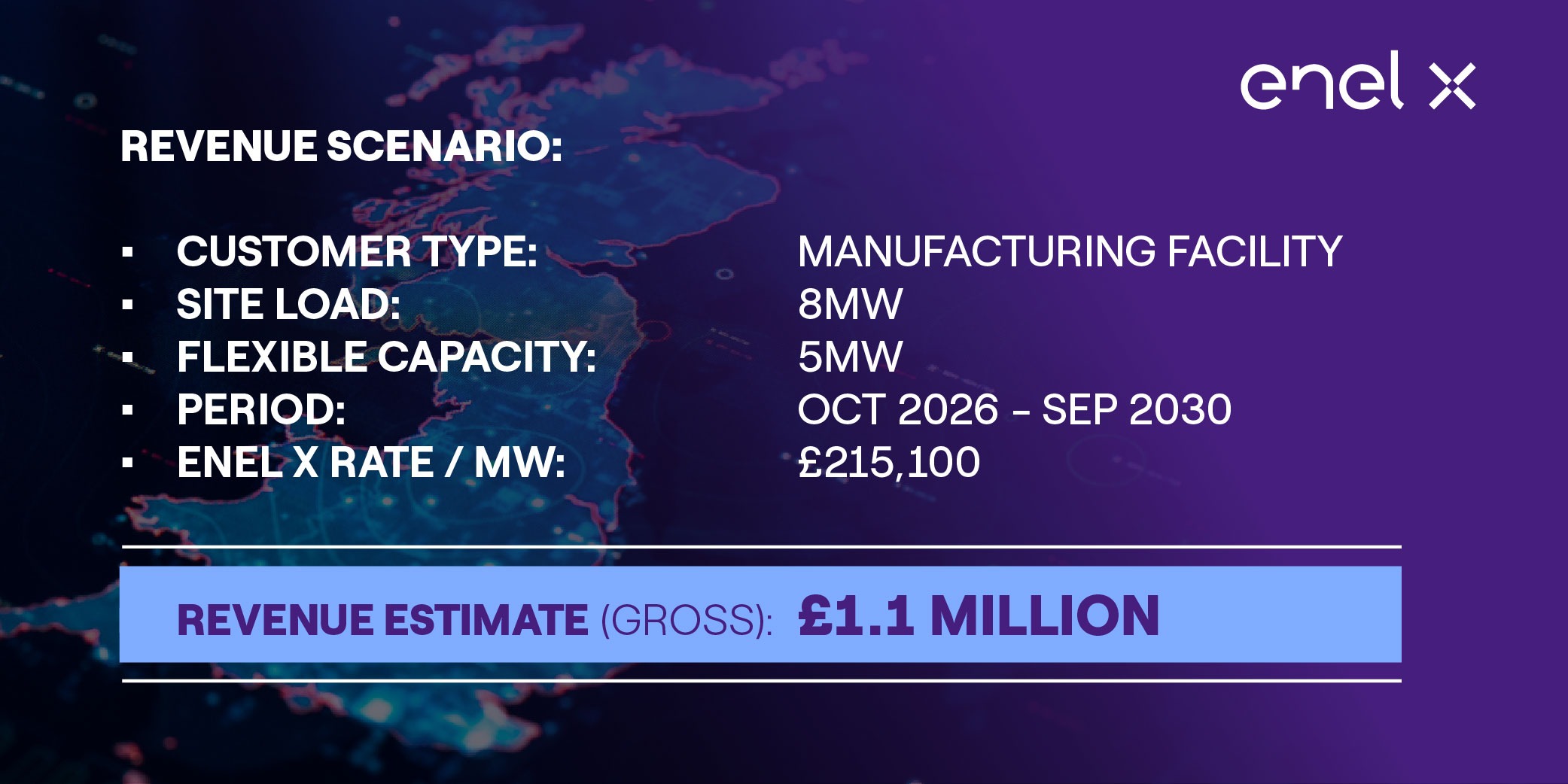 Revenue estimate based on Capacity Market participation with Enel X from October 1st 2026 to 30th of September 2030 subject to eligibility, terms and conditions. Auction results will remain provisional until confirmed by Secretary of State (23rd of March 2026) following the Auction Monitor’s report.
A growing role for flexibility
For many organisations, participation in the Capacity Market is only the starting point. Flexible assets can often unlock additional value by participating in multiple energy markets.
By participating in Enel X’s Virtual Power Plant (VPP), businesses can access additional revenue streams by stacking multiple energy market opportunities alongside their Capacity Market position.
Through coordinated participation across ancillary services, wholesale markets and other flexibility programmes, businesses can transform operational flexibility into a long-term energy revenue strategy.
Contact us to see how your business can participate in the Capacity Market and unlock additional value through Enel X’s Virtual Power Plant.
Related content

In this episode of Transmission: The Podcast, Michael Lynch, Manager of Enel X’s Global Network Operations Centre in Dublin, joins Ed Porter from Modo Energy to discuss the critical role played by Virtual Power Plants (VPP) in helping stabilise global electricity grids.

This case study explores how collaboration between industry, energy aggregators and policymakers is reshaping the UK electricity landscape.

P415 is making GB wholesale energy markets more accessible by allowing flexible energy users to participate via independent aggregators like Enel X.
Enel X Solution